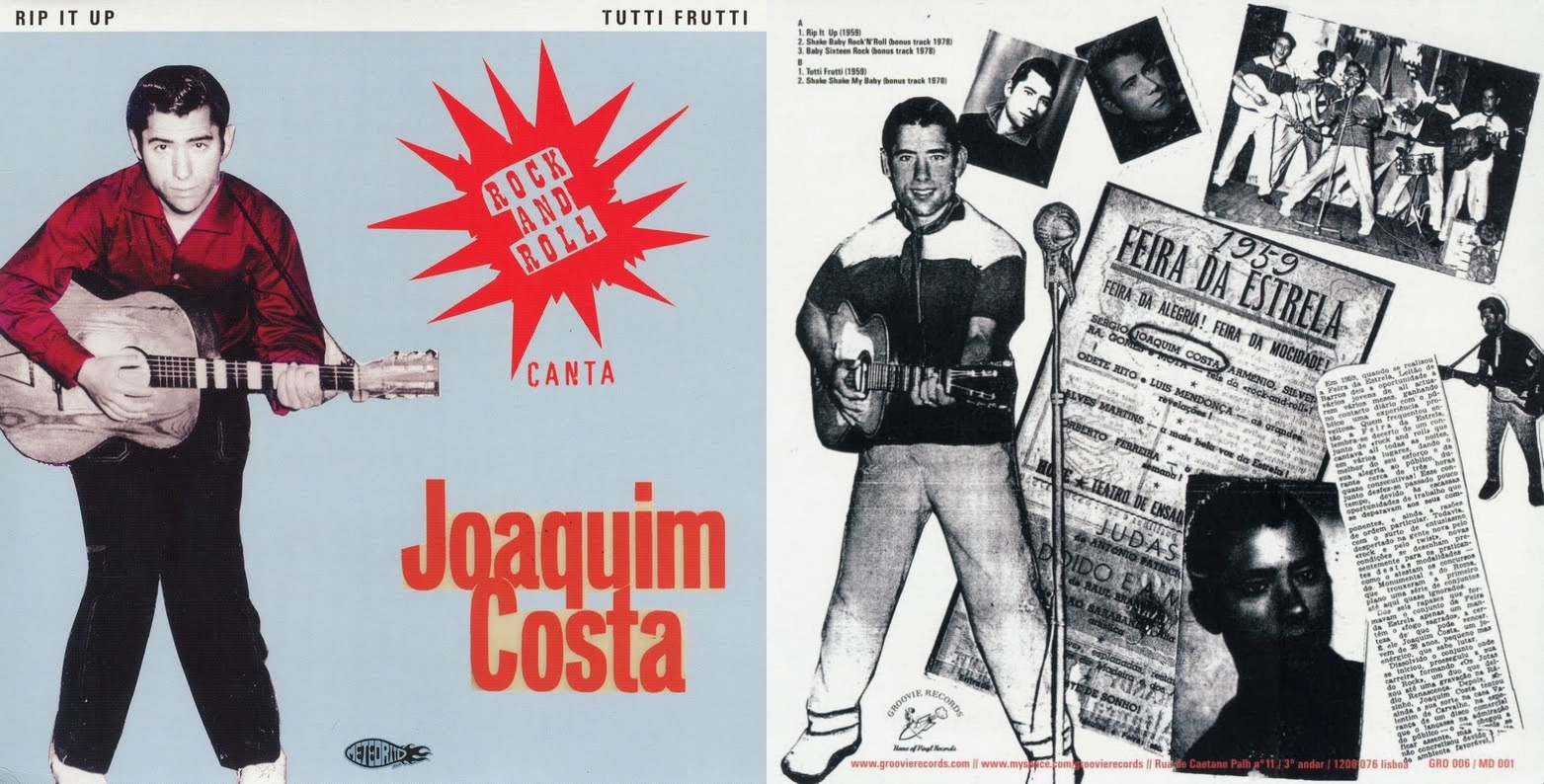
One morning, while entering Parque Mayer, where he stopped regularly, he heard “something strange.” It was a different sound coming from a jukebox placed in a small booth that time eventually did away with. It was Bill Haley & His Comets. Without any knowledge of English, Joaquim Costa decided to let his pompadour and sideburns grow and began the art of singing in his own way. Despite the linguistic muddle, his vocal tone helped him, while his ingenious vocalizations were enough to get by and make a good impression.
The first public demonstrations of this hidden talent did not take long to appear. An acquaintance who played in dance bands agreed to join some improvisational sessions at Jardim da Estrela. They would gather near a record machine and spend time sipping coffees, interspersed with drumming on tables and some tracks from the States. These crude open-air rehearsals bore fruit. The band, consisting of six members, learned that a cultural fair was being held at that location and went to the offices of Leitão de Barros, the space’s programmer, to see if they could participate.
The group ended up being hired. They earned 50 escudos per night, a fortune at the time, although the accidental rock hero quickly grew bored. Still in 1959, he sang at Mitra, included in the group of artists summoned for the Natal dos Hospitais, and he would not close one of the golden years of his life without recording a 78-rpm record at the old Rádio Graça, a cult object immortalized for just 200 escudos. He went to Valentim, showed the record, and they told him to leave it there and make a Portuguese version of a famous song.
A friend helped him translate the lyrics, but he hated it. He was a suspicious guy, always wary, and felt that through the song they were dismissing him, saying what they didn’t have the courage to say to his face. The other copy of the recording had been lost in the archives of Rádio Graça, which would eventually close its doors. Suddenly, Joaquim Costa saw both records slipping through his fingers. Like Indiana Jones searching for the lost ark, he began a frantic search, but without success.
Perseverant, he eventually found one of them thirty years after the recording at Feira da Ladra, a place where until recently he made a point of going every Tuesday and Saturday to scavenge for rock ‘n’ roll treasures. He still remembered that day in 1989 as the happiest of his life, believing he had already lost hope of finding the record and never letting it go again. “The Fabulous Costa,” another of the epithets invented to describe him, spent part of the 60s and 70s at half throttle, with concerts in various community centers, recreation houses, or at friends’ places.
He was part of the Jotas do Rock, a duo with whom he still recorded a trial at Rádio Renascença, although the track ended up being aired around one in the morning. His last public appearance was already in the 80s, on “Passeio dos Alegres,” Júlio Isidro’s mythical program where they tried to discover the Portuguese Elvis Presley. The “Elvis of Campolide” passed away in 2008, leaving behind a legacy as a unique figure in the history of Portuguese rock.
This story captures the essence of a man who, despite the barriers of language and the passage of time, remained dedicated to the rhythm that first captured his imagination in a small booth at Parque Mayer. His journey from an accidental hero to a cult figure illustrates a raw passion for music that transcended the technicalities of the industry. Joaquim Costa remains a symbol of an era where rock ‘n’ roll was a newfound language of rebellion and identity in Portugal, forever etched into the vinyl he fought so hard to recover.