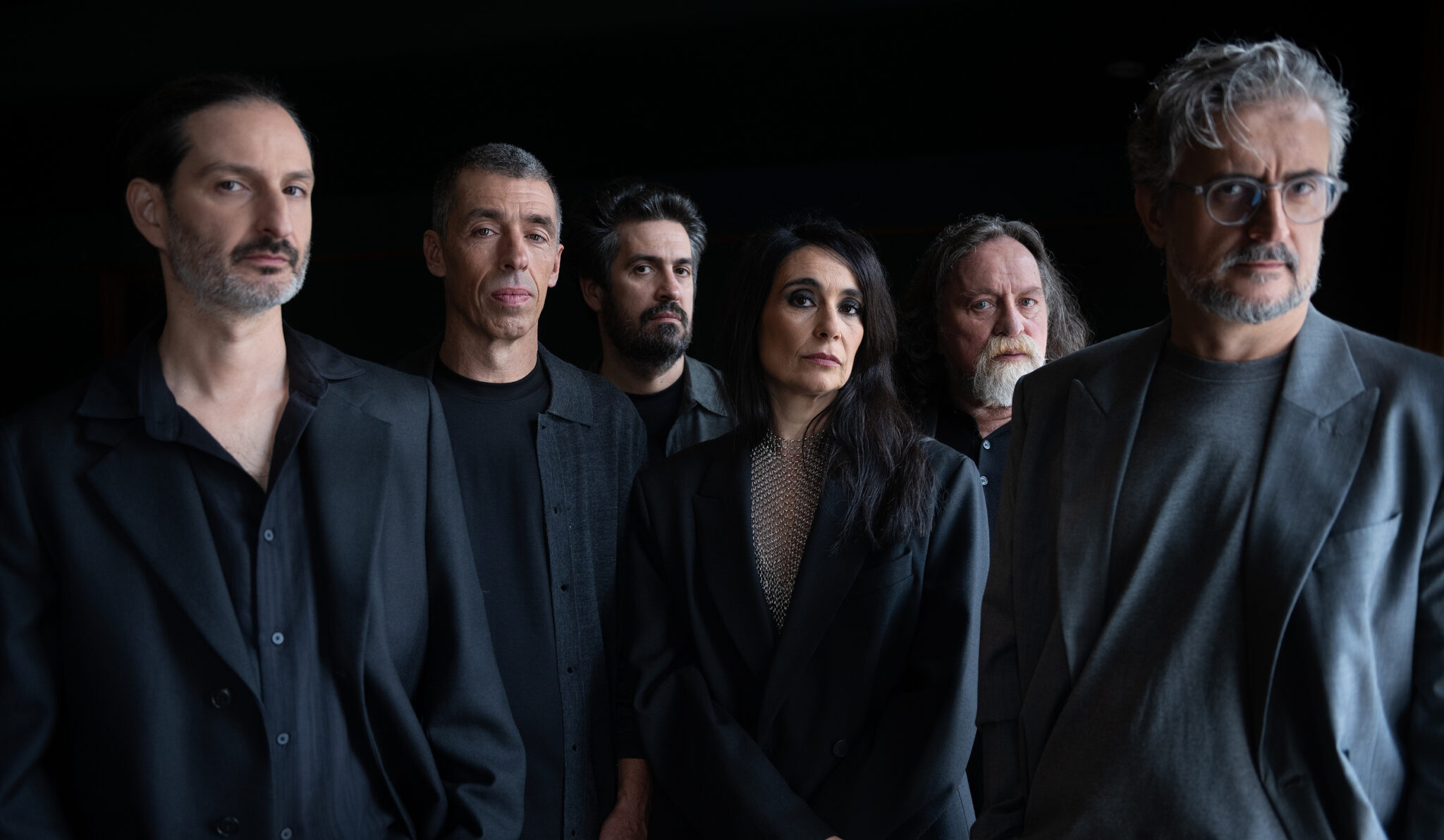
Formed in the mid-2020s and bursting onto the scene to critical acclaim between late 2023 and early 2024, Cara de Espelho quickly established themselves as one of the most significant, sharp, and artistically rich collectives in contemporary Portuguese music.
Far from being just a mere gathering of prominent names, the band was born out of an urgency to restore a poetic, satirical, and deeply popular dimension to protest and social intervention music.
1. The Genesis of a Deluxe Supergroup
The label “supergroup” is often applied lightly, but in the case of Cara de Espelho, it accurately reflects the background of six musicians who have shaped the sonic identity of Portugal over the past few decades:
- Maria Antónia Mendes (Mitó) — Vocals: Bearing an unmistakable, dense, and expressive timbre, she left her mark on Portuguese music history with A Naifa and later with Señoritas. In Cara de Espelho, her interpretation lends a biting restraint and a magnetic stage presence to the lyrics.
- Pedro da Silva Martins — Guitarras, Lyrics, and Composition: The creative mind behind the Deolinda phenomenon and iconic compositions for artists such as António Zambujo, Ana Moura, and Lena d’Água. He is the band’s primary lyricist, specializing in dissecting everyday contradictions with irony and poetic precision.
- Carlos Guerreiro — Multi-instrumentalist and Instrument Builder: A historic figure in traditional music and experimentation in Portugal. Founder of Gaiteiros de Lisboa and collaborator with veterans such as José Afonso, Sérgio Godinho, and Fausto, he brings a wealth of traditional instruments and custom organological inventions (from flutes and adufes to modified aerophones) to the group.
- Luís J Martins — Guitar: An exceptional instrument maker from Deolinda, whose aesthetic language and harmonic rigor refine the dialogue between acoustic tradition and contemporary arrangements.
- Nuno Prata — Bass: Longtime bassist for Ornatos Violeta and frequent collaborator on Lena d’Água’s projects. He provides a pulsating, flexible rhythmic foundation packed with a rock/folk groove.
- Sérgio Nascimento — Drums and Percussion: A veteran drummer in the Portuguese music scene (Humanos, Lena d’Água, Sérgio Godinho, They’re Heading West), delivering a vigorous percussive dynamic that sustains the band’s rich melodic palette.
2. Concept, Lyricism, and Sonic Identity
The band’s name summarizes its aesthetic and social purpose: to function as a mirror reflecting Portuguese society and its anxieties. The songs employ satire, irony, and sharp humor as tools to point out modern dynamics.
Protest Themes
The compositions of Cara de Espelho do not dwell in abstract protest; they target concrete contemporary issues:
- Identity and Immigration: In “Corridinho Português”, they dismantle xenophobic discourse and the obsession with “pure” blood, celebrating genetic and cultural miscegenation.
- Inequality and Real Estate Speculation: Tracks such as “Paraíso Fiscal” and “Aldeia Fantasma” portray a country up for sale, rampant touristification, and suffocating bureaucracy.
- Political and Social Satire: Songs like “Político Antropófago”, “Elefante no Hemiciclo”, and “Cara Podre” ridicule demagoguery, evasion of public responsibility, and the loss of decorum in democratic debate.
- Digital World and Post-Truth: Tracks such as “AI” address the impact of new technologies and misinformation on human relationships.
Musical Matrix
Sonically, the band builds a bridge between traditional Portuguese songwriting (corridinhos, chulas, marchas) and the attitude of alternative rock and progressive folk. The contrast between melodic sweetness, Carlos Guerreiro’s unusual acoustic timbres, and the hard-hitting lyrics creates an electrifying artistic tension.
3. Discography (Percurso Discográfico)
| Album | Year | Highlights | Context & Reception |
Cara de Espelho | 2024 | “Corridinho Português”, “Político Antropófago”, “Tratado de Paz”, “Paraíso Fiscal”, “Dr. Coisinho” | Self-titled debut album, unanimously praised by critics as the major Portuguese release of the year. Acclaimed across national press (Público, Expresso, Visão, Rimas e Batidas) and performed to sold-out auditoriums nationwide. |
B | 2026 | “Cara Podre”, “Bem-Vindo”, “D de Denúncia”, “Elefante no Hemiciclo”, “AI”, “A Seita” | The second studio installment further refined and elevated the group’s sarcastic writing. The release was accompanied by an extensive auditorium tour across key venues including Culturgest, Cineteatro Louletano, CCB, and Casa da Música. |
4. Impact, Recognition, and Awards
In a short period of activity, Cara de Espelho’s impact has translated into popular acclaim and official honors within the artistic community:
- PLAY Awards (Portuguese Music Awards): Awarded Best Reinterpretation of Traditional Music.
- Futurawards: Voted Best Band.
- Iberian Festival Awards: Nominated for Best Live Performance thanks to the vigor of their live shows.
- Critical Acclaim: Legendary singer-songwriter Sérgio Godinho summarized the band’s achievement by stating that Cara de Espelho masterfully fulfilled the mission of “seeing our individual faces in the shared mirror.”
The collective thus stands as one of the most revitalizing forces in recent Portuguese culture: a project that uses tradition to look the present in the eye, proving that protest music can be simultaneously poetic, danceable, and fiercely entertaining.
Visit the band website for more news and updates at https://caradeespelho.pt/biografia/