Music chooses no age. From the very first heartbeat we hear in the womb to the melodies that mark the different stages of life, the art of combining sounds accompanies human beings from beginning to end. However, it is upon reaching old age that music gains an extraordinarily therapeutic dimension, becoming a powerful ally for physical, mental, and emotional well-being.
- The Awakening of Memory and the Neuroscience of Sound
One of the most fascinating properties of music in senior age is its ability to access memories that seemed lost to time. Neuroscience studies show that areas of the brain responsible for musical memory (such as the supplementary motor area and the anterior cingulate cortex) often experience less degeneration than other areas associated with episodic memory, even in patients with dementia or Alzheimer’s.
- Memory Anchor Effect: When an older adult listens to a song from their youth or childhood, neural networks associated with the emotions of that era are activated.
- Recovery of Identity: Classic songs, traditional marches, or old radio tunes help seniors reconnect with their own biography, promoting moments of clarity and conversations rich in autobiographical detail.
- Mental and Emotional Benefits
As we age, changes in routine, loss of independence, or isolation can lead to cognitive decline and loneliness. Music acts as a complete and continuous neurological stimulus:
- Cognitive Stimulation: Listening to or playing an instrument engages multiple mental processes—attention, language, auditory perception, and motor coordination.
- Anxiety and Depression Reduction: Listening to music stimulates the release of dopamine and serotonin (neurotransmitters linked to pleasure and well-being) and reduces cortisol levels (the stress hormone).
- Social Connection: Group activities, such as choirs or shared listening sessions, directly combat social isolation by fostering a strong sense of belonging.
- Physical and Motor Impact
Beyond neurological benefits, music is a natural driver of movement and rehabilitation:
- Balance and Gait: A steady rhythm serves as an external metronome, helping regulate steps and prevent falls.
- Fine Motor Skills: Playing simple percussion instruments or keyboards improves hand and joint mobility.
- Respiratory Capacity: Choir singing improves diaphragm control and lung capacity.
Practical Suggestions for Daily Life
To ensure music plays a transformative role in a senior’s daily routine, it should be introduced intentionally and personally:
- Create a “Life Playlist”: Gather a selection of memorable songs (focused on ages 15 to 30), as this period usually holds the strongest musical memories.
- Active Stimulation with Simple Percussion: Tapping along to the rhythm of familiar songs using tambourines, maracas, or handclaps enhances coordination and focus.
- Daily Radio or Guided Listening Sessions: Set aside a dedicated time of day solely for listening to the radio or albums without external distractions, encouraging the individual to share what each song reminds them of.
- Senior Choirs or Singing Groups: Participating in choirs stimulates auditory memory, breathing, and strengthens community bonds.
Music in old age is not merely entertainment; it is a bridge between the past and the present, a natural remedy for the mind, and an ongoing celebration of life.
Practical Guide to Music Therapy and Musical Activities in Care Homes
1. Institutional Approaches: Different Degrees of Intervention
To apply music effectively in a care home, it is essential to distinguish between the levels of practice:
- Clinical Music Therapy: Conducted by a certified music therapist. It utilizes specific techniques (such as guided musical improvisation and neurological assessment) aimed at individual therapeutic goals, such as post-stroke rehabilitation or supporting advanced stages of dementia.
- Cultural Animation and Senior Stimulation: Conducted by socio-cultural animators or gerontology teams. It focuses on socialization, the maintenance of affective memory, body expression, and general well-being.
- Institutional Sound Environment: The management of sound in common spaces (avoiding excessive noise or televisions left on in the background without purpose), creating intentional moments of calm or energy throughout the day.
2. Practical Implementation: Weekly Program in Care Homes
| Activity | Main Objectives | Format and Required Resources |
| Rhythm and Percussion Workshop | Fine motor coordination, attention, and rhythm | Tambourines, maracas, triangles, or lightweight drums. Exercises involving the imitation of clapping patterns. |
| Guided Listening / “Memory Circle” | Retrieval of remote memory and socialization | Choice of one theme per session (e.g., “Spring Songs,” “1960s Dance Music”). Each resident shares what the theme reminds them of. |
| Senior Choral Singing | Lung capacity, vocal articulation, and a sense of belonging | Weekly rehearsal of popular or traditional repertoire, adapted to the vocal range of the seniors. |
| Movement and Seated Dance | Balance, joint mobility, and circulation | Arm and leg exercises to the rhythm of the music, maintaining the safety of seated residents. |
3. Individualized Strategy: Music in Daily Care
In addition to group activities, music can be integrated directly into the daily routines of caregivers and nurses:
- Management of Critical Moments: Playing soft and familiar music during hygiene, feeding, or medication routines reduces episodes of agitation or physical resistance in residents with cognitive decline.
- Individual Listening Stations: Setting up simplified audio players (or headphones) with personalized playlists created by family members or caregivers for moments of anxiety in the bedroom.
- Community Partnerships: Inviting local folk groups, music students, or community choirs for regular performances at the care home, bringing the outside community closer to the residents.
Exemple of Project Proposal: “Sounds of Memory”
Musical Animation and Stimulation for the Elderly
- Attn: Technical Direction and Management Board
- Scope: Sociocultural Animation and Cognitive Stimulation
- Proposed Duration: 6 Months (Renewable)
- Frequency: 2 Sessions per Week (45 to 60 minutes per session)
1. Justification and Framework
Institutionalized aging brings additional challenges in combating sedentarism, emotional isolation, and cognitive decline. Music, when applied in a structured and intentional way, acts as a complete neuropsychological stimulus, activating brain areas linked to affective memory, motor coordination, and emotional well-being.
The “Sounds of Memory” project emerges to complement the institution’s activity plan, promoting the transition from passive listening to active participation by residents.
2. Project Objectives
General Objectives
- Promote quality of life, emotional well-being, and socialization of residents through musical practice.
- Preserve the identity and life story of each service user through the retrieval of musical memory.
Specific Objectives
- Cognitive: Stimulate sustained attention, language, short- and long-term memory, and time-space orientation.
- Physical/Motor: Increase upper limb joint mobility, balance, and fine motor coordination through rhythmic dynamics.
- Emotional and Social: Reduce episodes of anxiety and agitation, promote a sense of belonging to a group, and prevent depressive states.
3. Methodology and Practical Activities
Sessions will be divided into 4 structured dynamics:
- Welcoming and Vocal/Body Warm-up (10 min): Breathing exercises, posture adjustments, and simple vocalizes adapted to the senior vocal range.
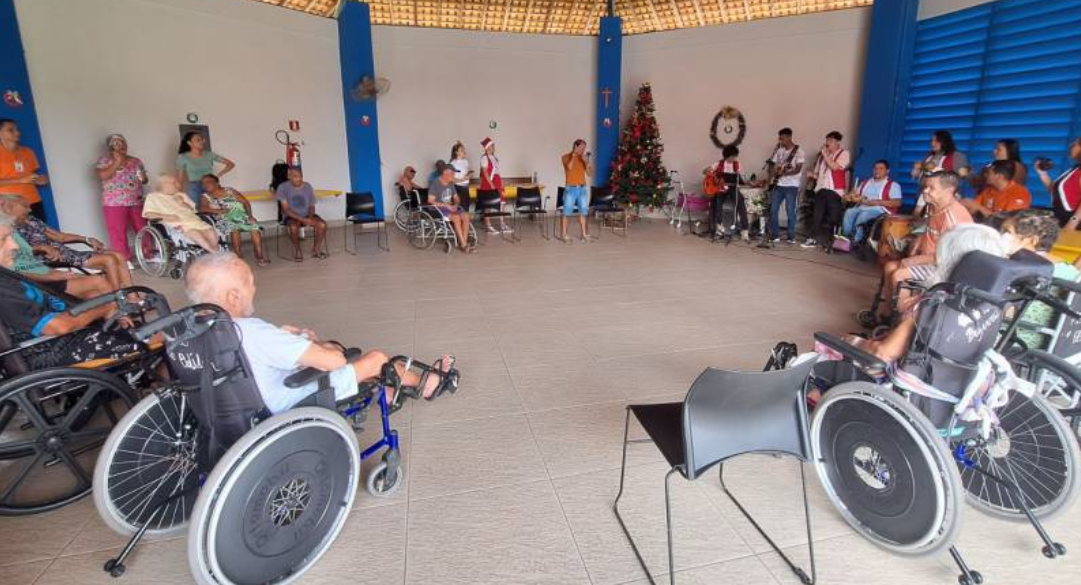
- Active Rhythm and Percussion Circle (15 min): Rhythmic accompaniment of familiar songs using light percussion instruments (tambourines, maracas, rattles, triangles).
- “Culture and Memory” — Guided Listening (20 min): Themed sessions (e.g., Traditional Marches, Traditional Fado, Work Songs) followed by the sharing of memories and personal stories associated with the themes heard.
- Relaxation and Return to Calm (10 min): Guided listening with soft music for deceleration and integration of the well-being generated during the session.
4. Weekly Action Plan (Sample Schedule)
| Tuesday (10:30 AM) | Thursday (3:00 PM) |
| Rhythm and Coordination Workshop (Motor focus and attention) | Singing and Memories Circle (Cognitive focus and socialization) |
| Work with light percussion instruments and seated dance. | Interpretation of traditional repertoire and sharing of life stories. |
5. Necessary Resources and Logistics
- Spatial Resources: Common or activity room with enough space to arrange chairs/wheelchairs in a circle.
- Material Resources:
- Portable Bluetooth sound speaker.
- Basic Orff/senior percussion kit (10 to 15 lightweight, easy-to-grip instruments).
- Audio player for support.
- Human Resources: 1 Project facilitator supported by 1 Direct Action Assistant / In-house Animation Technician during the sessions.
6. Project Impact Evaluation
To ensure transparency and demonstrate the value of the project to Management, three evaluation instruments will be used:
- Individual Observation Form (Monthly): Recording parameters such as participation, attention level, pre- and post-session mood, and mobility.
- Satisfaction Survey (Semiannual): Applied to residents with preserved cognitive capacity and their respective families.
- Review Meeting with the Technical Team: Regular coordination with Technical Direction and Psychology/Occupational Therapy to adjust dynamics for users with specific needs.
7. Financial Proposal
(Space reserved for adaptation according to local budget or internal/external service provision)
- Provision of Services / Monthly Cost: € [Value] (Includes facilitation of [X] monthly sessions and preparation of pedagogical material).
- One-time Investment in Equipment (in case the institution lacks a percussion kit): Estimated at € [Value].
Conclusion
The “Sounds of Memory” project represents a direct investment in the humanization of care and the valorization of residents. I remain at your disposal to schedule an in-person meeting and conduct a complimentary, no-obligation demonstration pilot session at your facilities.
Sincerely,
- [Your Name / Title]
- [Phone Numbers / Email]
- [Date]