
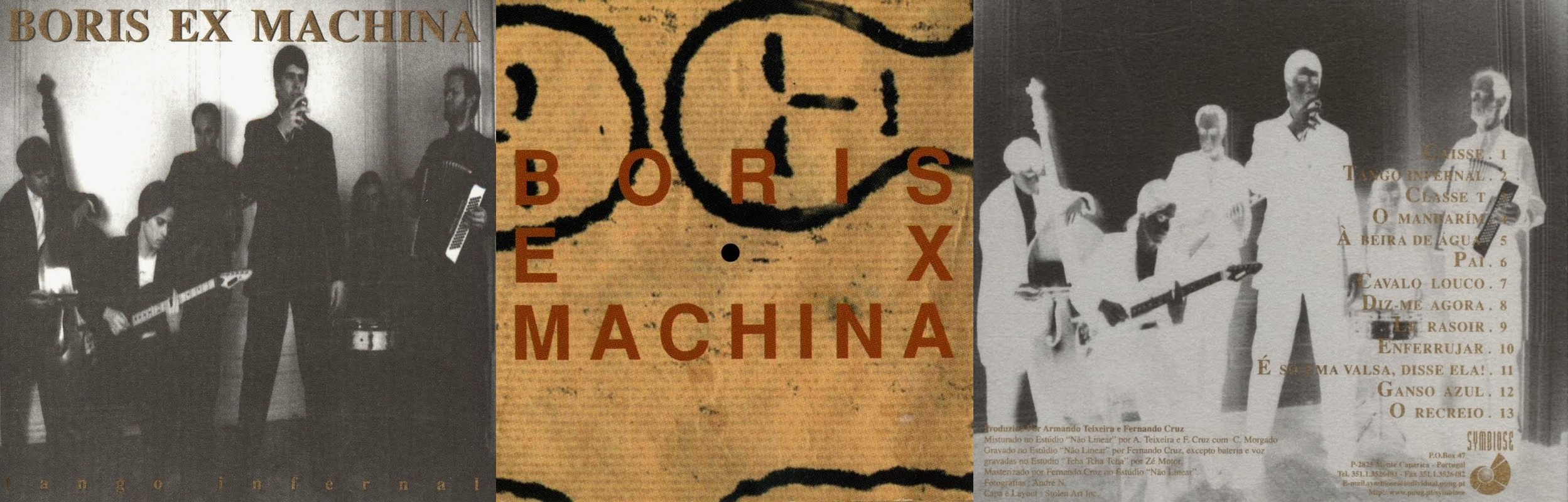
In the labyrinths of Portuguese alternative music during the 1990s, some projects were born not just to fill the silence, but to challenge the aesthetic conventions of an era. This was how the seed of Boris Ex Machina germinated—a unique collective initially conceived through the creative complicity between Armando Teixeira, responsible for vocals and programming, and Carlos Costa on guitar. What began as an intimate dialogue between two individuals quickly felt the need to expand its sonic and human horizons, transforming into a living, multifaceted organism.
To give shape to this ambitious vision, the original duo opened their doors to new accomplices who would help mold the identity of Boris Ex Machina. Joining the journey were Carlos Morgado, who brought the weight of a second guitar, Ernesto on the rhythmic drive of the drums, and Miguel Leiria Pereira, providing the acoustic depth of his double bass. The final and most picturesque color of the group, however, came directly from the pavement of Lisbon: Rini Luyks, a master of the accordion, was recruited while sharing his art on the emblematic Rua do Carmo, bringing the bohemian soul of the streets into the studio.
Far from the mainstream spotlight, the group assumed deep and complex aesthetic influences with an almost reverent shyness. Boris Ex Machina drank openly from the musical theater and rawness of Kurt Weill and Bertolt Brecht, while also allowing themselves to be infected by the dark avant-garde of Tuxedomoon. However, they categorically rejected the easy comparisons that critics of the time tried to draw with the British band Tindersticks, digging their heels into the urgent need to build an identity that was entirely and unmistakably their own.
The great dream of this collective was, in fact, a utopian fusion: they longingly envisioned sharing the stage with a classical orchestra. In the plans of Boris Ex Machina, high culture crossed paths with popular folklore in a panoply of references that embraced the melancholy of tango and fado, the cadence of the waltz, and the liveliness of the polka. Above all, there was a non-negotiable manifesto that anchored the entire project: the celebration of the Portuguese language, the chosen vehicle to give voice to their urban narratives.
Yet, trapping Armando Teixeira in a single stylistic drawer was always an impossible task, and Boris Ex Machina was merely one of his many facets. Too restless and versatile to confine himself to a single genre, the musician already carried an impressive resume of sonic chameleonism. His path included the industrial density of Bizarra Locomotiva and the sonic explorations of Ik Mux. Even more surprising to many, Teixeira had also been a fundamental piece in the rhythmic pulse of Da Weasel, the mythical band that was revolutionizing hip-hop in Portugal.
His hunger for reinvention would not end there, projecting itself into the future through solo adventures that left a mark on the national scene, such as the projects Balla and Bulllet. But it was precisely in the skin of Boris Ex Machina that the musician found his darkest and most cinematic altar. There, backed by a dense array of electronic machinery, Teixeira fully embraced the posture of a modern cabaret singer. It was a markedly melancholic, nocturnal, and paradoxically pleasant universe, where the acoustic warmth of the cello and accordion humanized the coldness of the machines.
In this incarnation with Boris Ex Machina, his literary and musical references became evident. The almost diabolical, biblical torment carried by old American bluesmen—which Nick Cave so brilliantly embodied in his career—served as a mirror for Armando. Similarly, the sluggish, booze-soaked spirit with which Stuart Staples, frontman of Tindersticks, balanced his melancholic litanies, found an echo in the Portuguese musician’s posture.
However, Armando Teixeira’s Portuguese roots introduced a unique nuance into this transatlantic formula operated by the band. Instead of losing himself in the alcoholic vertigo or the nicotine dependence that characterized his international peers, Teixeira proposed something different: a circumspect Tony de Matos, operating in a sort of conceptual slow-motion. The decadence of foreign cabarets thus gave way to the literary and existentialist temptation of Mário de Sá-Carneiro, dressing the songs in the heartbreak of the “Orpheu Generation.”
Naturally, there were rough edges to smooth out during this stage of the project’s maturation. Critics of the era did not hesitate to point out that Armando’s voice still suffered from a certain technical weakness and fragility when compared to the weight and density of his great intellectual idols. Even so, the only record born from Boris Ex Machina proved to be a document of immense cultural interest, functioning as a true turning point in the artist’s career.
In the long run, this album acted as the catalyst for an inevitable choice. Armando Teixeira would eventually distance himself progressively from his more alternative and heavier projects, such as Bizarra Locomotiva and Da Weasel, where his energy had been divided. The richness of the musical approach developed in Boris Ex Machina—more mature, poetic, and theatrical—demanded his exclusive and consistent dedication, solidifying his status as one of the most courageous architects of Portuguese independent music.

Existem aquelas bandas que ninguém conhece, e depois existe(iu) os “Boris Ex Machina”. E não, não estamos a falar do filme.
Nos labirintos da música alternativa portuguesa dos anos 90, alguns projetos nasceram não apenas para preencher o silêncio, mas para desafiar as convenções estéticas da época. Foi assim que germinou a semente do Boris Ex Machina.