If a historian ever decides to examine the early 2000s over here, they’ll have to face a phenomenon as bizarre as it is fascinating: the birth of the Lord’s Punk Rock on Portuguese soil! It might sound exotic, but for anyone who lived through post-modernism, it makes total sense.
It all started with hardcore bands in the 90s and culminated in the FlorCaveira collective, which generated enough media noise to put Christian bands on the rosters of major labels like Universal. It was a movement with Protestant roots that was later joined by the Catholic collective Amor Fúria.
And let’s be honest: if Portugal were truly that secular and democratic, we’d already have Jewish Rock and Allah Pop on radio rotation! But in a country where Hip-Hop and Kuduro took decades to shed prejudiced labels, my guess is that only around 2035 will we get hit with the Ali Baba Core or The Shalom All Stars.
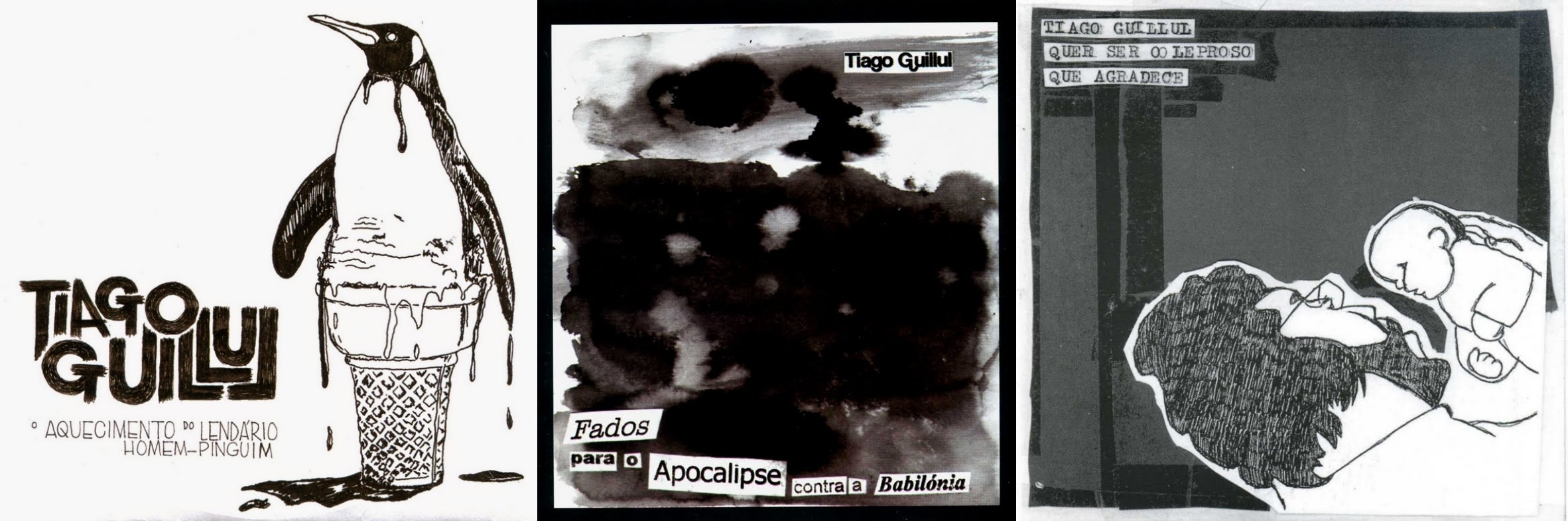
But let’s get down to business and the man at the center of it all: Tiago Guillul. His debut came in 2002 with Fados para o Apocalipse contra a Babilónia (Fados for the Apocalypse Against Babylon), perhaps the highest and most intimate moment of his first phase—which also includes the 2003 releases, Mais dez fados religiosos (Ten More Religious Fados) and Tiago Guillul quer ser o leproso que agradece (Tiago Guillul Wants to Be the Grateful Leper).
Here we have Guillul at his best as a singer-songwriter, where fado appears in a mutant and residual form, picking up more quirks than formal templates—and thank goodness, because nobody has patience for the plague of cheesy “fadunchos”! The lyrics move effortlessly between autobiography, social criticism, biblical imagery, and direct Christian messaging.
With a timbre that often recalls the Violent Femmes, the core sound is acoustic, but without fear of turning to the computer to drop loops and noise. That technological side stands out in Mais dez fados…, where it almost seems to border on an António Variações without the libido and closer to Sunday school.
Meanwhile, the EP Tiago Guillul quer ser o leproso que agradece connects to the electricity of rock. Guillul embraces the DIY (“do it yourself”) spirit to its ultimate extreme: he plays guitar, bass, drums, designs the covers, produces, and edits. It’s impossible not to highlight the gem “A Isabel é intelectual” or memorable titles like “Tu tens o coração do tamanho do Salmo 119” (“You Have a Heart the Size of Psalm 119”).
We arrive at Tiago Guillul’s fourth release—setting aside the noisy side project Borbulhas Borboletas. This is a great Pop record, a great lo-fi work, God-illuminated and sung in Portuguese with a courage rarely seen anymore. The stigma of “Christian punk” is something that haunts him, but Guillul plays it to his advantage using intelligence and refined humor.
If Guillul had had a Brian Eno by his side, the album V would have been his Remain in Light. It’s the record that should have served as the blueprint for Portuguese Pop 20 years ago—with the irony being that the Talking Heads classic is from 1980, proving once again our chronic two-decade delay behind the rest of the world.
This V has nothing punk about it; it’s nostalgic Pop, indebted to New Wave and No Wave that drew inspiration from African polyrhythms. Guillul, punk rocker and Protestant pastor, owned the paradox: he brought Portuguese back to modern music, recovered the memory of the 80s (complete with a guest appearance by Rui Reininho), but perhaps erred on the side of excessive singer-songwriter tropes.
The vinyl version of V included a bonus CD-R: O Antes e Depois dos Gratos Leprosos (The Before and After of the Grateful Lepers), a project he maintained until 2005 prior to Os Lacraus and the FlorCaveira media explosion. Tiago Lacrau (or Guillul, or Cavaco) was the driving force behind this entire movement, unearthing talents like Jorge Cruz and creating a wave that saved us from the plague of certain musical atrocities on national radio.
While Portuguese music was invaded by a wave of singer-songwriters who softened over time and with public exposure, Guillul remained the great exception. He continues to provoke, record, and release music without giving in to commercial formulas, using punk, metal, and world music to paint a raw, real portrait of 21st-century Portuguese society.
To close this cycle comes Amamos Duvall (2012), a completely anachronistic double album where Guillul asserts himself as a true “outsider artist,” a restless visionary on the level of a Daniel Johnston. A double release packed with humor, social critique, and the creative urgency of a spirit that simply refuses to stand still.
(Adapted from the original text by Marcos Farrajota / Chili Com Carne)