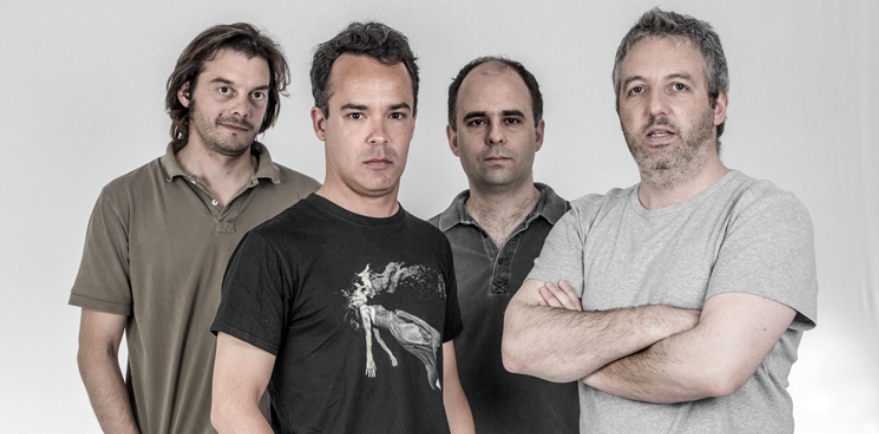
Although all its members originated from the city of Porto, the genesis of the Urbanature project actually has its roots in Coimbra, around 1996. It was there that Luís Madureira began, almost as a hobby, to dedicate himself to sonic experiments and to explore the capabilities of his computer. These were the first easygoing steps in building a sound that would later acquire its own very distinct identity.
João Marques soon joined these initial explorations, adding his guitar. Besides layering his instrumental textures onto that growing electronic amalgamation, Marques showed an increasing interest in the behind-the-scenes work of music creation, particularly the electronic side and the manipulation of samplers. During this period, the two musicians were also part of the Valium project with drummer Francisco Cardoso, viewing these new experiments as a parallel creative outlet.
It was with the addition of Nuno Camacho on bass that the project began to gain a more solid structure. Those sounds that had started “as a game” quickly transformed into composed tracks, where ambient lines harmoniously intersected with electronics that, at times, were raw and abrasive, but at other moments undeniably invited dancing. The band was finding its voice.
This new form compelled them to take a further step. They sent a very raw demo, which they titled “Volume 1,” to the magazine “Promúsica,” a reference publication at the time. To the members’ surprise and excitement, the magazine selected two of those tracks for inclusion on its prestigious promotional CDs.
This initial recognition became a turning point. Suddenly, what was an alternative activity transformed into a project that demanded to be treated with a different level of seriousness. From then on, the pace quickened, and the band focused on recording two more demos, one of which carried the evocative name of “100% Natural.”
In parallel with the evolution of their recordings, Urbanature sought to make their sound more organic and analog, a crucial step that would allow them to take to the stage and showcase their work live. The ambition was clear: to transform studio electronics into a tangible and engaging experience for the audience.
The effort culminated in 1999 with the release of “Evergreen,” their debut record released by Independent Records. This album marked the peak of their production and, shortly thereafter, the band decided to conclude their activities. A relatively swift end to a story that, despite its brevity, left its mark on the Portuguese music scene.
Naturally, as happens with any band exploring electronics, some questions were raised. There were whispers that a large part of the sounds used in their tracks were simply downloads from internet sites. Were these merely “bad tongues” speaking, or was there some truth to the rumours? The answer remains part of the folklore of their short, yet intense, existence.
They also released at least three music videos for singles from that album:
- “Plug and Pay” (released in June 2018)
- “Chasing the Sun” (released in December 2019)
- “Stellar Path” (released in September 2020)
Furthermore, the band celebrated its 25th anniversary in January 2021 and mentioned that they were already working on material for a third album in 2019. They are credited as being the first Portuguese band to use a computer as a musical instrument on stage.