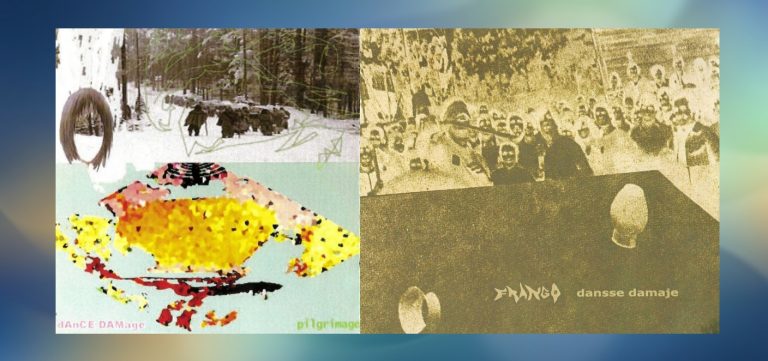

They are a generation of bands averse to labels, musically situated on the periphery, where they explore new sound territories outside the mainstream currents. Bearing “weird” names—such as Frango, Caveira, Tropa Macaca, Aquaparque, Osso, or Lobster—they “invade” the margins with less obvious music that is freed from orthodoxies and unconcerned with popularity. Some call them “the bastard sons of rock.”
“The periphery is buzzing like never before in Portuguese music. There are a number of bands with weird names playing in many venues across this country,” says André Gomes, a contributor to Blitz magazine.
“The carefree, hedonistic, marginal, and ritualistic attitude linked to rock is omnipresent in the background of most of the names suggested here,” notes Sérgio Hydalgo, programmer at Galeria Zé dos Bois (ZDB).
“In Portugal, especially in Lisbon and largely due to ZDB’s programming—at the time led by Pedro and Nélson Gomes—a significant number of individuals emerged with a taste for experimenting with the song format and creating outside the rules of major labels,” adds the host of the Má Fama radio show, which promotes less media-exposed Portuguese music on Rádio Zero and Antena 3.
Bruno Silva, a member of the band Osso, asserts that this peripheral generation has always existed, “even if in a more subcutaneous way,” but that the last three or four years have been particularly active.
Pedro Gomes, a member of Caveira and co-founder of the cultural association Filho Único, dislikes labels, but summarizes this generation in one sentence: “They are people making non-standardized, non-mass-market music, doing whatever they feel like.”
They reject labels, but it is known that they produce tirelessly in a self-sufficient manner (often releasing on CD-R, cassette, or through netlabels), multiply across various bands, and perform in any space—a reflection of people driven by urgency.
Frango, for instance, has ties to projects like PCF Moya and Barcos; Tiago Miranda from Loosers, Afonso Simões (ex-Fish&Sheep, now in various projects such as Phoebus, Curia, etc.), and Nélson Gomes (also a founder of Filho Único) formed Gala Drop; Símio Superior (André Abel) joined Ju-Undo to form Tropa Macaca, and teamed up with Pedro Magina for Aquaparque.
“For every project that dies, ten others are born, and that is a direct reflection of hyperactivity and urgency,” says André Gomes.
A member of Loosers—considered by many to be the pioneers of this wave of bands—Tiago Miranda justifies this proliferation of bands as a kind of “extension of friendship,” highlighting that it is a big family driven by the desire to play creative music.
Joaquim Durães, co-founder of Lovers & Lollypops (a label, distributor, and promoter of this peripheral music), states that the urgency to play and the use of more immediate formats, like CD-Rs, reflect the “need to share what one creates with others.”
CD-R labels like Searching Records, Lovers & Lollypops, nemnuncadiscos, Let’s Go To War, and Ruby Red, alongside netlabels Test Tube and Merzbau, host the latest peripheral Portuguese music. “We are talking about a DIY (‘do it yourself’) wave. It boils down to a matter of regularity—some of these bands release four albums a year, something impossible for most mainstream acts,” explains André Gomes, who is also a member of DOPO, one of the bands in this circuit. “Music is recorded one week and available as an album the next—free and often complimentary,” he adds.
Bruno Silva explains that the CD-R format and netlabels are “a natural counterpart to the tangible emergence of this music, while also being tied to low financial resources.” In Pedro Gomes’s view, however, the CD-R format doesn’t allow for the long-term preservation of the music. “The whole idea of DIY,” he argues, “is very cool and spontaneous, but as a document that lasts, it doesn’t really work. I think anyone mature enough to make music wants to leave a lasting mark.”
With fluctuating output and soundscapes ranging between experimentation, improvisation, and noise, unifying the sound of these bands is a challenge.
Nevertheless, there is an attempt to explain what this “new” peripheral Portuguese music sounds like. “A large portion of the bands are indeed confrontationally noisy, but there are others exploring less harsh territories,” says André Gomes.
By: Marta Poiares, Lusa, 22-12-2007