
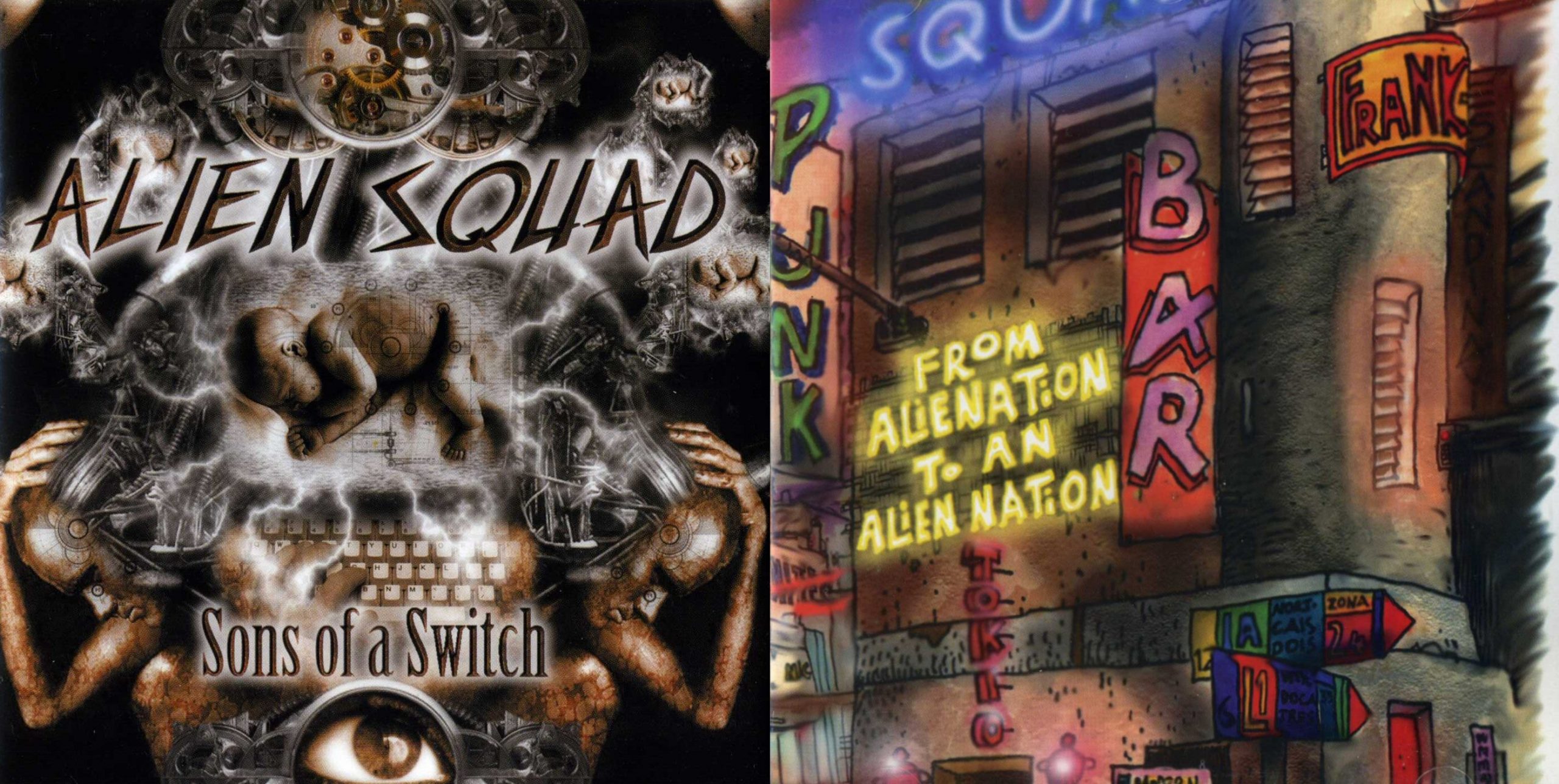
The history of Alien Squad dates back to the late 1980s in Leiria, when a group of friends decided to join forces to create noise and meaning. Originally, the collective went by the name Alien Spider Webs, a clear nod to their admiration for the British band Alien Sex Fiend. This early phase, consisting of Cláudio, Pedro Cabunje, Paulo Pessanha, Moura, and Cab, served as the laboratory where their first ideas began to take shape.
From that embryonic period, very few sonic memories remain for posterity, with only the tracks “Raging Boys Transformation” and “Police on the Streets” surviving. It was a time of experimentation and a search for a unique identity within a Portuguese musical scene that was still beginning to boil. These compositions laid the foundation for what would eventually become one of the benchmarks of the national underground.
The turning point officially occurred on November 12, 1989, a date considered the true birth of the Alien Squad project. As the group evolved, Paulo Pessanha decided to focus exclusively on the guitar, shifting the band’s sonic dynamics. This transition to a dual-guitar lineup brought a greater density to the compositions that were starting to be drafted.
Over time, the band underwent several natural lineup changes, seeking the ideal balance between energy and technique. Eventually, the group reached its most iconic and stable formation, featuring Cláudio on vocals, Xano on bass, Hugo on drums, and P.A. on guitar. It was this quartet that consolidated the characteristic sound that fans grew to respect.
Musically, Alien Squad positioned themselves on the border between hardcore and thrash metal, creating an energetic and raw crossover style. Although they emerged in the late 1980s, their first official record, titled “From Alienation to An Alien Nation,” did not see the light of day until the year 2000. The album functioned as a manifesto, summarizing a decade of political and musical resistance through a compilation of landmark tracks.
Interestingly, the liner notes of that first CD included an honest and almost nostalgic warning, informing listeners that certain tracks might sound dated. This transparency showed that the band was fully aware of their trajectory and the temporal context in which the songs were created. The album was, above all, a historical document of the evolution of punk in Portugal.
The group’s lyrics were always loaded with a heavy socio-political charge, firing against the injustices of the system with the rawness typical of the crust movement. Themes such as war, religion, racism, and environmental degradation were recurring, serving as a voice of denunciation. Animal rights also held a central place in their discourse, keeping the flame of punk activism alive.
While the debut work still showed a certain instrumental and lyrical naivety, the second album revealed surprising maturity. The sound became more cohesive and structured, moving toward a more polished sonority that merged thrash and core without losing its aggressive essence. There was a clear effort to raise the technical bar of their musical execution.
The evolution was not limited to the instruments but was also reflected in more careful and incisive songwriting. Social critiques became sharper and more wide-reaching, targeting everyone from the political class to the contradictions of “trendy” ecologists. Even if the musical structures remained somewhat predictable, the delivery and the message gained newfound prominence and importance.
In a gesture of innovation and camaraderie with the local scene, the group decided to close that second work with a creative approach. They invited other projects—Plastik Leiria Bombers, R8374C, and Seas of the Moon—to reinterpret original Alien Squad tracks. These final versions brought new perspectives to the band’s work, celebrating the creative diversity of the Leiria region.
The legacy of Alien Squad is indisputable, as they are remembered as the second punk band to emerge in Leiria, following the pioneers Jesus Morto Da Cruz. Beyond their own discography, the seeds planted by their members gave rise to other influential projects, such as Injusticed League. Thus, the band’s name remains engraved in history as a fundamental pillar of Portuguese crossover.