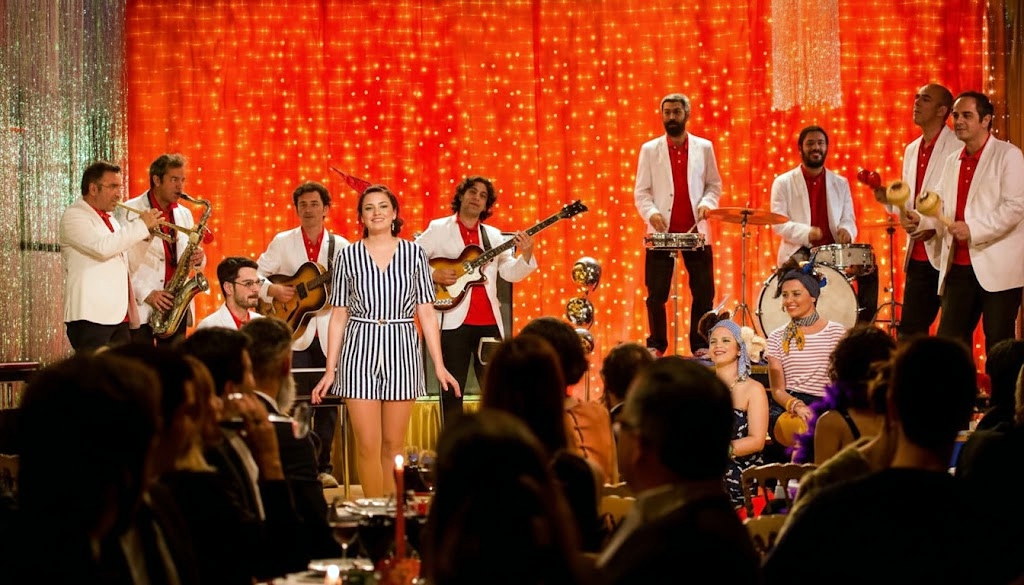
With a repertoire primarily consisting of timeless classics and lost gems of Portuguese music, Real Combo Lisbonense is a group that revives the spirit and repertoire of the 1950s and 60s orchestras and dance bands through a modern lens.
In 2014, Real Combo Lisbonense debuted a new show entirely dedicated to Carmen Miranda’s repertoire, alongside the album “Saudade de Você,” featuring a selection of songs from that performance.
In a world transforming at an ever-accelerating pace, we run the risk of irretrievably leaving behind many brands, objects, habits, and forms of cultural expression. In music, one of the traditions that has been lost is that of the orchestras and ensembles which, in the mid-20th century, enlivened the casinos, hotels, bars, and restaurants of major Western metropolises. Lisbon was no exception; despite its small-scale metropolitan nature and the limitations imposed by the regime, the decades following World War II saw a vibrant scene of venues dedicated to socializing and dancing.
These were times of various constraints, and such places served as an escape and a release for individual and collective emotions. Simultaneously, the development of tourism ensured a flow of cosmopolitan clients flocking to Portugal in search of sun, entertainment, and a certain quasi-tropical exoticism. It was in this environment that Portuguese Pop music began, the result of a fertile series of diverse convergences.
Starting from a matrix based essentially on the traditions of light and romantic song, fado, and folklore, elements from other styles were progressively and naturally incorporated, following fashions and contact with the outside world. Substantial improvements in communication routes and the creation of the TAP Imperial Line led to inevitable contact with the most modern trends from abroad. This is how influences were brought to us and quickly assimilated by young Portuguese musicians: sounds and rhythms originating from South America—especially Brazil, but also Cuba, Mexico, and Argentina; sounds from Africa—via the former colonies, mainly Cape Verde and Angola; and a new style of European popular song from Italy, Spain, and France. All of this was in addition to American jazz and the international styles emerging at the time—twist, yé-yé, and rock’n’roll.
This particularly rich moment in Portuguese music was, to a large extent, stifled by the political regime of the time. This happened directly through various censorship mechanisms and, more indirectly, due to the impact of the colonial war on many sectors of the country—the mandatory draft of all young men into the army for an exceptional war effort made it impossible for many musical groups to maintain their regular activities. The period that followed, both before and after the April 74 revolution, was also not conducive to the development of Pop music expression, particularly dance music. The urgency, motivations, and aesthetic foundation of that era were focused elsewhere.
Today, half a century later, it is precisely this spirit and heritage that the formation of Real Combo Lisbonense seeks to recover. This is not a return to outdated values or aesthetics, nor is it a gratuitously revivalist exercise; rather, it is the recovery of something vital and of clear interest that was lost in the frantic race of progress that tramples everything and makes everything forgotten.
Despite its genetic code revealing deep popular roots, the morphology of RCL incorporates multiple modern components, both instrumental and scenic, that bridge the gap between the past and the present. In this way, its music aspires to be unifying, transgenerational, trans-social, and transcultural.
Young and old, rich and poor alike—with a wink to everyone, Real Combo Lisbonense invites you to dance!