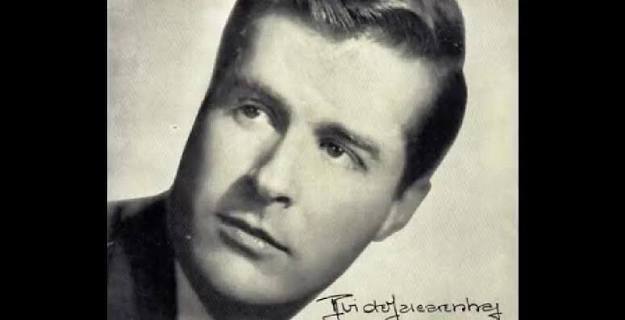
Born in Vila Pery, Mozambique, on December 14, 1928, under the registered name Rui de Pinho Ferreira, Rui de Mascarenhas distinguished himself as one of the most versatile and cosmopolitan performers of mid-20th-century Portuguese music. His childhood was marked by frequent moves due to his father’s career as a military officer, leading him to live in mainland Portugal and later in the Azores, where he attended the Antero de Quental National High School in São Miguel.
Although he initially entered higher education at the Lisbon School of Fine Arts to study architecture and later attended the Naval School, Rui de Mascarenhas’s fate was irrevocably bound to music. His official artistic debut took place in 1951 during the live advertising broadcasts of Passatempos APA, transmitted directly from the prestigious Éden Cinema in the Portuguese capital.
His profile on the national stage grew rapidly through his participation in the iconic radio show Companheiros da Alegria, hosted by Igrejas Caeiro. It was during this early phase that he immortalized one of his most popular songs, “Encontro às Dez,” a composition written by Jerónimo Bragança and Nóbrega e Sousa that became a cornerstone of his repertoire.
Endowed with a refined vocal technique that seamlessly transitioned between fado-canção and bolero, the singer quickly earned critical acclaim and popular success. His talent won him notable awards, including the Interpretation Prize from Emissora Nacional, as well as international accolades, such as an award at the 1957 Geneva Festival, a Gold Medal at Cannes in 1961, and first prize at the Costa Verde Festival in Spain in 1963.
Seeking to expand his career internationally, Rui de Mascarenhas moved to France in 1959. During his four-year stay in French territory, he achieved a historic milestone by becoming, second only to Amália Rodrigues, the second Portuguese artist to perform at the iconic Olympia venue in Paris.
After a brief stint in Spain, the performer moved to the United States in 1964, where he lived for eighteen years. In North America, he established a regular circuit of performances at major venues in cities such as Miami Beach and Los Angeles, while maintaining occasional collaborations in Portugal, including recording the television special Canções por Rui de Mascarenhas for RTP in 1965.
In the early 1980s, he relocated to Canada, where he diversified his artistic engagements. During this period, in addition to making frequent appearances on local television programs, he joined the cast of the celebrated operetta The Merry Widow, standing out as the only Portuguese performer in a French-speaking production with a cast of 120 people.
His discography includes recordings on vinyl records and compilations, featuring albums such as Amor and Mourir Ou Vivre, released in the 1960s by record labels Movieplay and EMI-Valentim de Carvalho. Signature songs like “Maria Helena” and “Pauliteiros do Douro” solidified his name in the classic catalog of Portuguese popular music.
His definitive return to Portuguese stages was scheduled for late February 1987, with a performance planned at the Loucuras venue (formerly Jardim Cinema) in Lisbon, accompanied by the Orquestra da Felicidade do Brilho e da Glória under the direction of José Nuno Martins. However, four days before the concert, on February 22, 1987, the artist passed away suddenly in the city of Porto at the age of 58 due to a cerebral embolism.
The singer’s memory remains preserved in the history of Portuguese light music and through urban toponymy. In tribute to his career and cultural contribution, the municipality of Caldas da Rainha named a street after him in the parish of Nossa Senhora do Pópulo.
Top Hits and Notable Songs of Rui de Mascarenhas
Throughout his career, Rui de Mascarenhas became known for his smooth vocal delivery, easily bridging traditional Portuguese melodies, fado-canção, and romantic Latin genres like the bolero. Below are the key tracks that defined his musical career and established his reputation both in Portugal and abroad:
- “Encontro às Dez”Composed by the legendary duo Jerónimo Bragança and Nóbrega e Sousa, this track stands as the defining landmark of Mascarenhas’s early career. Launched during his rise on national radio in the 1950s, it remains one of his most recognized and enduring classics.
- “Maria Helena”A prominent showcase of his romantic style, this ballad gained widespread popularity across Portuguese-speaking audiences and became a staple of his live international repertoire.
- “Pauliteiros do Douro”Demonstrating his connection to traditional Portuguese folk themes, this popular track highlighted his ability to adapt regional cultural motifs into refined, accessible popular music.
- “Amor”The title track of one of his major studio LPs released in the 1960s, “Amor” captures the lush, orchestra-backed romantic pop style that earned him accolades across European song festivals.
- “Mourir Ou Vivre”Released during his time living in France in the early 1960s, this song reflects his international crossover period, coinciding with his historic performances at the Paris Olympia.
References
- Serra, Maria João. “Rui de Mascarenhas.” Rádio CidadeFM (archived).
- Rádio e Televisão de Portugal (RTP). “Canções por Rui de Mascarenhas” (1965).
- Caldas da Rainha City Council. Toponymic Guide of the City of Caldas da Rainha, p. 43 (2015).
- Lisbon Municipal Sound Library (Fonoteca Municipal de Lisboa). Catalog records for “Rui de Mascarenhas: O Melhor dos Melhores” and “Encontro às Dez.”