
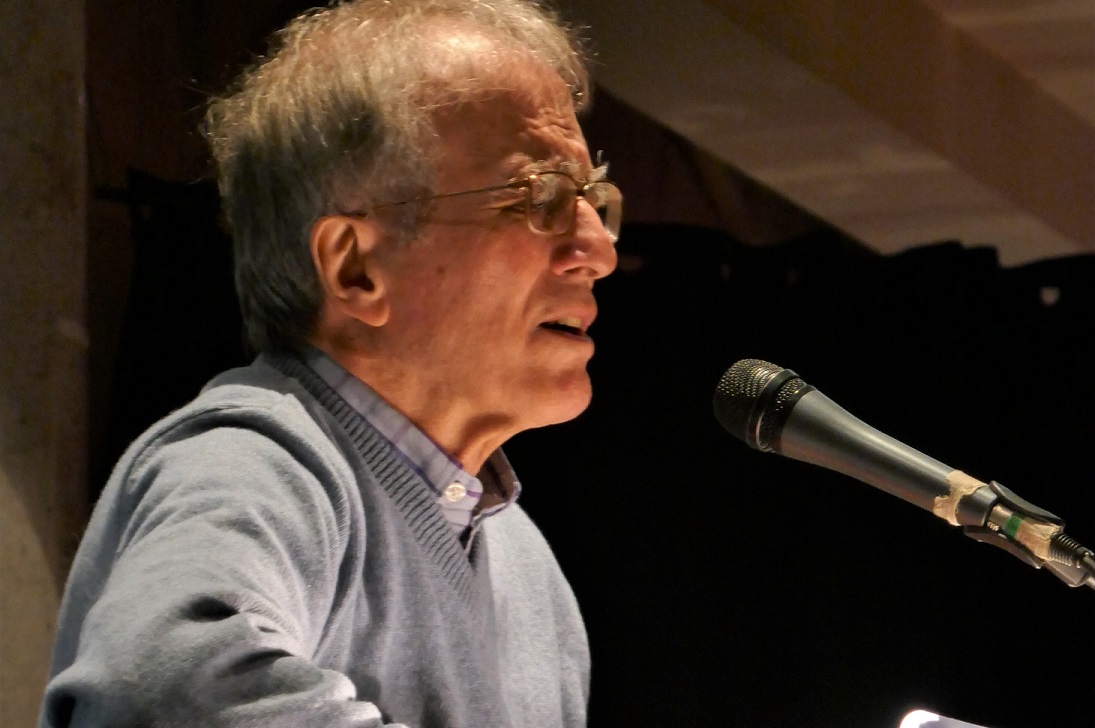
From the Seminary to the First Steps in Music
Born on May 17, 1941, in Praia do Ribatejo, in the municipality of Vila Nova da Barquinha, Francisco Júlio Amorim Fanhais spent his early childhood in the Ribatejo region before moving to Entroncamento. Influenced by the local clergy, he entered the seminary at just ten years old. Over the course of more than a decade, he attended seminaries in Santarém, Almada, and Olivais, in Lisbon, where he earned a degree in Theology.
He was ordained as a priest at the age of 23 by the then Cardinal-Patriarch Manuel Gonçalves Cerejeira, celebrating his first mass on Maundy Thursday in 1965 at the parish of Benfica. Alongside his theological studies, however, Fanhais developed a solid musical background. He studied solfège, Gregorian chant, and choral singing, even performing with the National Broadcasting Symphony Orchestra in high-profile religious ceremonies across the capital.
Political Consciousness and the Progressive Catholic Movement
Music acted as the primary catalyst for his political awakening. Still during his seminary days, Francisco Fanhais began secretly listening to the songs of José Afonso, a figure he would come to regard as pivotal to his critical consciousness regarding the regime. Close contact with Father José da Felicidade Alves, a staunch opponent of the Estado Novo’s colonial policy, eventually put him under the surveillance of the secret police (PIDE).
He thus became part of the movement known as the “progressive Catholics,” who, ever since the historic letter sent by the Bishop of Porto, D. António Ferreira Gomes, to Salazar in 1958, openly challenged the dictatorship. The masses he celebrated and the Religion and Morals classes he taught at the high school in Barreiro became gathering points for young dissidents and frequent targets of regime espionage.
National Breakthrough on Zip-Zip and Protest Songs
In December 1968, while teaching at the diocesan seminary of Torres Novas, he met José Afonso in person during a youth cultural event. The friendship and artistic synergy between them developed rapidly, leading Zeca Afonso to sponsor Fanhais’s television debut on the iconic show Zip-Zip in 1969.
The impact of his voice and message was immediate. Later in 1969, he released his debut EP, Cantilenas, and featured on the cover of the very first issue of the magazine Mundo da Canção. In 1970, he released the landmark album Canções da Cidade Nova. Among his most influential tracks were compositions based on the poetry of Sophia de Mello Breyner Andersen, notably Cantata da Paz, whose lines — “We see, we hear, and we read / We cannot ignore” — became an inescapable motto of antifascist resistance.
Rupture with the Church and Exile in France
The irreversible break with the Catholic Church hierarchy occurred in August 1970, when Fanhais attended the civil and religious wedding of Father José da Felicidade Alves in Vila Franca de Xira—an act performed against the explicit directives of the Patriarchate. Summoned to testify before the Ecclesiastical Tribunal of Lisbon, he refused to recant and reaffirmed the integrity of his positions.
As a consequence, he was suspended from the priesthood and barred from teaching in public schools. Left without a livelihood and facing constant persecution by the PIDE, he joined the National Commission for Aid to Political Prisoners and, in April 1971, made the decision to emigrate to France. He settled first in Lyon and later in Paris, working in theater, voiceover for French television, and the Portuguese service of the BBC.
Recording Grândola, Vila Morena and Political Activism
During his exile in Paris, he joined forces with singer and composer José Mário Branco. Together, they organized dozens of concerts for the Portuguese emigrant community and distributed antifascist literature, remaining under strict surveillance by PIDE informants abroad. During this period, Fanhais radicalized his political involvement, becoming an active member of the League of Revolutionary Unity and Action (LUAR), led by Hermínio da Palma Inácio.
In October 1971, at the invitation of José Mário Branco, he traveled to the Château d’Hérouville studios to participate in the recording of the historic album Cantigas do Maio by José Afonso. It was in this context that he lent his voice to the backing vocals of Grândola, Vila Morena—the song that would later be chosen as the decisive broadcast signal for the Armed Forces Movement to initiate the Carnation Revolution on April 25, 1974.
Return to Portugal and National Recognition
The outbreak of the Carnation Revolution caught Francisco Fanhais in France, but his return to his homeland was immediate. During the turbulent post-April 25 months, he actively participated in the MFA’s Cultural Dynamization Campaigns, singing at dozens of popular rallies, political meetings, and festivals across the country alongside figures like Adriano Correia de Oliveira and Sérgio Godinho.
Later, as democratic life normalized, he returned to teaching as a Music Education teacher in public schools, a career he pursued until his retirement. On June 9, 1995, the President of the Republic awarded him the rank of Officer of the Order of Liberty for his invaluable contribution to the cause of democracy and free thought.
Today, while keeping his Catholic faith and the consistency of his journey intact, Francisco Fanhais serves as the president of the board of the José Afonso Association, where he continues to preserve the work and legacy of his great friend and master.
Selected Discography
- 1969: Cantilenas (EP, Orfeu)
- 1970: Canções da Cidade Nova (LP, Zip-Zip)
- 1971: Corpo Renascido (EP, Zip-Zip)
- 1998: Dedicatória (Reissue of the 1970 LP featuring the original handwritten note by Zeca Afonso)



Francisco is Portugal number one singer