The confusion between hip-hop and rap is one of the most common misunderstandings in contemporary music. Often, these two terms are used interchangeably, but the truth is they are not the same thing. Think of them like a tree and one of its strongest branches: one wouldn’t exist without the other, but the branch is just a part of something much bigger.
If you’ve ever found yourself debating with friends where one ends and the other begins, or if you simply want to deeply understand the roots of this movement that shaped global culture, this article will untangle that knot in a simple, detailed, and human way.
What is Hip-Hop? The Whole Culture
To understand hip-hop, we need to go back in time—specifically to the 1970s, in the Bronx, New York. Hip-hop was born at street parties (the famous block parties) organized by Black, Latino, and Jamaican youth who were looking for an escape valve from the social vulnerability, poverty, and violence surrounding the area. Therefore, hip-hop is not a musical genre; it is a cultural movement and a way of life.
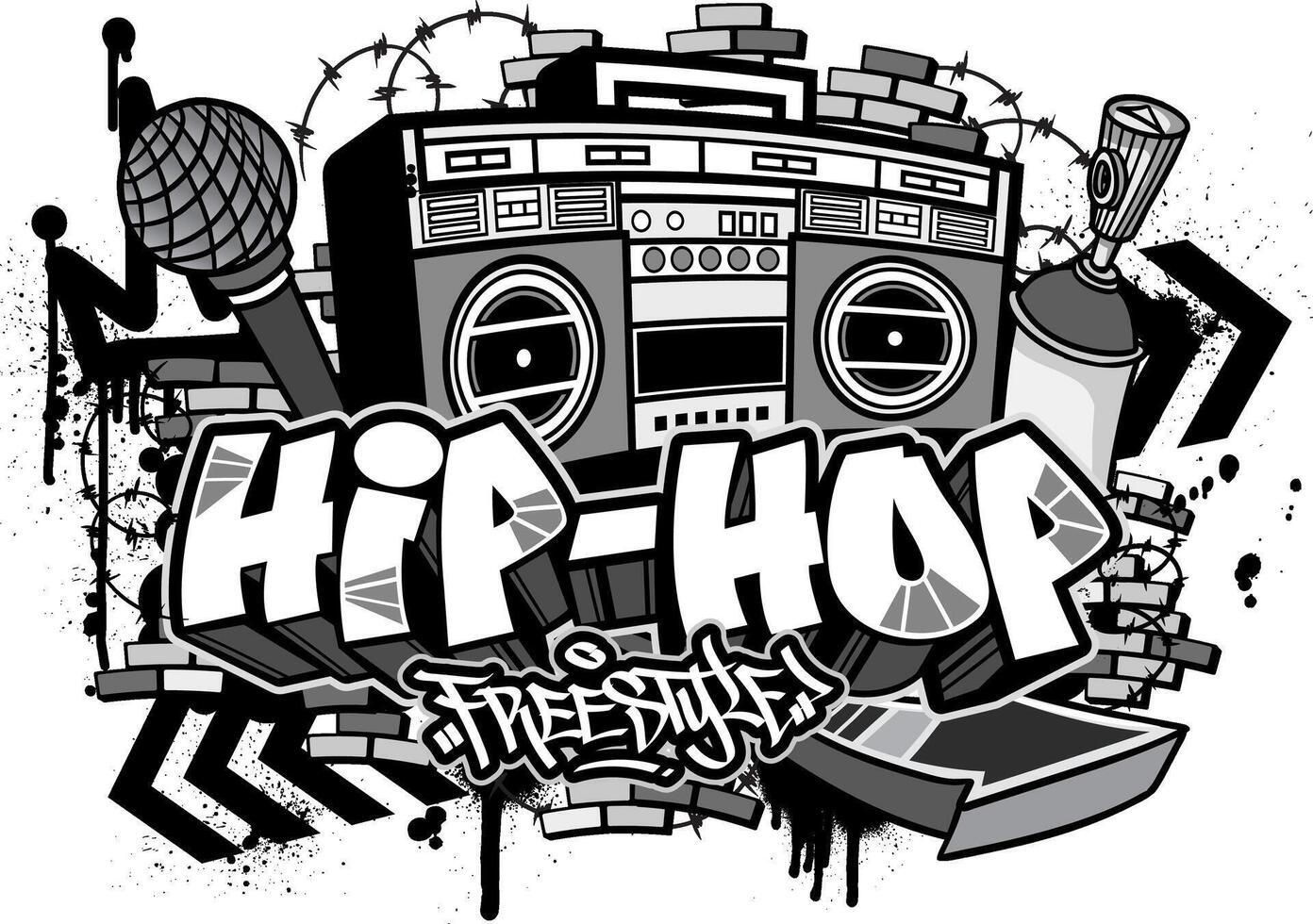
This culture is sustained by four fundamental pillars, as outlined by pioneers like Afrika Bambaataa. Each pillar represents a form of artistic and social expression:
- DJing: The rhythmic heartbeat. DJs like Grandmaster Flash and DJ Kool Herc revolutionized music by isolating the percussion sections of songs (the breaks) and looping them using two turntables simultaneously. This created the foundation upon which all urban music would grow.
- Breaking (Breakdance): The physical expression. The youth who danced frantically during these musical breaks became known as B-boys and B-girls. Breaking transformed gang rivalries into acrobatic, style-infused dance battles.
- Graffiti: The visual identity. Urban art on the walls and subways of New York served as the visual voice of a youth that society tried to make invisible. It was a way to claim territory, protest, and splash color across gray city streets.
- MCing (Master of Ceremonies): The voice of the movement. And this is exactly where rap enters the story.
What is Rap? The Technique and the Rhythm
Rap (an acronym many associate with Rhythm and Poetry) is the musical expression of the MCing pillar. It is a vocal technique, a musical genre, and a form of verbal expression. Rap consists of speaking rhythmically and in rhyme over an instrumental beat.
In the early days of the Bronx block parties, the MC’s role was simply to hype up the crowd, greet people, and keep the energy high while the DJ played. Over time, these rhymed shout-outs evolved. MCs began telling complex stories, chronicles of daily life, political protests, and personal reflections.
The structure of rap is based on three essential technical elements: content (what is being said), flow (the cadence, rhythm, and speed at which the words are delivered), and delivery (the performance, tone of voice, and emotion of the artist).
Concrete Examples to Tell Them Apart
To make this distinction crystal clear in your mind, let’s look at how this plays out in the real world:
1. Rap Outside of Hip-Hop
Because rap is a musical technique, it can exist completely detached from hip-hop culture.
- Linkin Park: The rock/nu-metal band uses rap as its primary vocal delivery style through Mike Shinoda (as heard in the classic “In the End”), but the band’s visual aesthetic, attitude, and context belong to the alternative rock universe.
- Modern Pop and Trap: Pop artists frequently invite rappers to feature on their songs purely for the commercial aesthetic of the rhythm, without any connection to the origins or pillars of the Bronx.
2. Hip-Hop in Its Fullness
When we look at artists who live and breathe hip-hop, rap is just one of the tools they use to express that culture.
- Emicida (Brazil): He doesn’t just rhyme (rap)—his entire career is built on the ideals of hip-hop. He started in freestyle MC battles, his clothing reflects urban fashion, his lyrics reclaim the history of the Black community, and he actively works as a social and cultural changemaker.
- Kendrick Lamar: His songs aren’t just rap tracks; they are deep artistic concepts that discuss the reality of the streets of Compton, cultural heritage, structural racism, and suburban visual art. He uses rap as a vehicle to manifest hip-hop.
The Evolution Timeline
To understand how the relationship between the two has changed over the decades, it’s worth looking at the key moments in this history:
- 1970s — The Big Bang in the Bronx: In 1973, DJ Kool Herc hosts the famous party at 1520 Sedgwick Avenue. Hip-hop is born as a community grassroots culture. Rap emerges organically and through improvisation to hype up these parties.
- Late 1970s — The Commercialization of Rap: In 1979, the Sugarhill Gang releases “Rapper’s Delight.” For the first time, rap is recorded in a studio and becomes a commercial product on the radio. The music begins to walk independently from street culture.
- 1980s and 1990s — The Golden Era: Groups like Public Enemy, Run-D.M.C., and Wu-Tang Clan expand rap globally, but maintain tight-knit bonds with graffiti, breaking, and the urban fashion of hip-hop. In Brazil, Racionais MC’s take on this role as chronicles of the periphery.
- 21st Century — The Era of Trap and Stadiums: Rap becomes the most listened-to musical genre on the planet. Subgenres like Trap emerge. Rap gains total autonomy: an artist today can top global charts making rap music without necessarily being part of traditional hip-hop culture.
Quick Summary: Hip-Hop vs. Rap
If we had to summarize everything we’ve discussed into a direct comparison, it would look like this:
| Feature | Hip-Hop | Rap |
| Nature | A collective cultural movement | A musical genre and vocal technique |
| Composition | Made of 4 pillars (DJ, Break, Graffiti, MC) | Made of rhythm, poetry, flow, and a beat |
| Where it lives | In fashion, dance, visual arts, and attitude | In headphones, on stages, in rhymes, and studios |
| Example of practice | Spray-painting a wall, dancing in a cypher, community organizing | Writing rhymed verses over a drum beat |
Understanding this difference isn’t about being picky or technical. It’s a form of historical respect. When we validate hip-hop as a culture, we recognize the power of a marginalized community that transformed social exclusion into one of the greatest artistic movements in human history. And when we value rap, we celebrate the evolution of modern poetry and urban storytelling coming through our speakers.