Folklore is much more than a collection of old dances or colorful costumes stored in the trunks of local associations. It represents the soul, resilience, and accumulated wisdom of a people throughout the centuries. On August 22nd, the world celebrates World Folklore Day, a date that takes on a very special meaning in Portugal—a country where oral tradition and ethnographic expressions remain alive and pulsing from north to south, across the islands, and reaching out to our global diaspora.
To speak of folklore in Portugal is to take a journey back in time and immerse oneself in the intangible richness of a nation that knew how to fuse its rural, maritime, and religious experiences into a unique identity. Throughout this article, we will explore the origins of this celebration, the immense diversity of our regions, and the crucial importance of keeping this legacy burning for future generations.
The Origin of the Word and the Historical Context
The choice of August 22nd to celebrate folklore on a global scale is no coincidence. It dates back to the year 1846, when the British archaeologist and writer William John Thoms coined the term “folklore” in a letter sent to the famous London magazine The Athenaeum. Thoms joined two Old English words: folk (meaning people) and lore (which translates to knowledge, instruction, or wisdom). The goal was to create a unified concept that encompassed what had previously been scatteredly referred to as “popular antiquities.”
In Portugal, the reception of this concept and the systematic study of popular culture began to gain momentum in the late 19th and early 20th centuries, led by intellectuals and ethnographers who realized that galloping modernization risked erasing oral traditions. Since then, the term has taken deep root in the national vocabulary—initially closely linked to the collection of folk tales, legends, and romances, and later expanding into the dynamics of folklore groups (ranchos folclóricos).
It is crucial to note that, in addition to the World Day in August, Portugal also instituted its own National Day of Portuguese Folklore, celebrated on the last Sunday of May. This dual annual celebration reinforces the pride the country takes in its cultural roots and serves as a launching pad for the countless summer festivals that liven up Portuguese towns and cities.
The Mosaic of Portuguese Folklore: A Journey Through the Regions
If there is one characteristic that defines Portuguese folklore, it is its remarkable regional diversity. Despite being a geographically small country, Portugal displays an impressive variety of costumes, songs, and rhythms, shaped by the geography, climate, and livelihoods of each community.
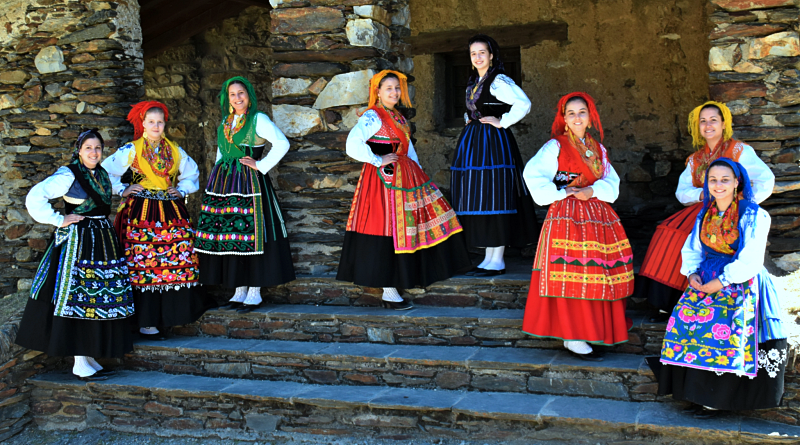
In the Minho region, folklore is synonymous with exuberance and celebration. It is impossible to talk about this region without evoking the iconic Trajes de Lavradeira (traditional seamstress costumes) from Viana do Castelo, rich in red embroidery and showcasing the family gold on the chest (the famous filigree beads and hearts). Minho dances, such as the vira, caninha-verde, and chula, are fast-paced, energetic, and translate into a contagious joy that draws thousands of visitors to festivals like the Festa da Senhora da Agonia.
Moving down to Trás-os-Montes, folklore takes on a different cadence, more closely tied to the land and ancestral rituals. Here, the Pauliteiros de Miranda stand out, performing the “stick dance” to the sound of the bagpipe, preserving the unique cultural identity of the Miranda region. Further south, in the Beiras, the sounds become more melancholic and communal, heavily influenced by harvest and working songs that used to set the pace for daily agricultural life.
In the Ribatejo, culture revolves around the Tagus River, the plains, and the figure of the campino (the local cattle herder). The Ribatejo fandango is the king of dances, characterized by vigorous tap dancing and a constant challenge between two men competing in agility and footwork. The costumes reflect field work but gain elegance and vibrant colors during festive performances.
Arriving in the Alentejo, the scenery changes radically. Alentejo folklore is dominated by Cante Alentejano, classified as Intangible Cultural Heritage of Humanity by UNESCO. This is a polyphonic choral singing, performed entirely a cappella (without any musical instruments), echoing the harshness of field labor, nostalgia, and love for the land, sending shivers down the spine of anyone hearing it for the first time.
In the far south, the Algarve brings the sharp rhythm of the corridinho, a fast-paced partner dance where dancers spin quickly, nearly glued to the floor, to the sound of the accordion. Meanwhile, in the autonomous regions, folklore gains the freshness of the Atlantic: in the Azores, the “Chamarrita” dances stand out for their strong social component; and in Madeira, the iconic “Bailinho da Madeira” takes center stage, accompanied by the unique sound of the brinquinho (a traditional instrument made of rag dolls with castanets).
Beyond the Dance: Legends, Gastronomy, and Oral Tradition
A common mistake is reducing folklore solely to groups and music. Folklore is, by definition, the “lore of the people,” and this includes oral heritage and everyday life dynamics. Portuguese legends and myths—such as the stories of the Enchanted Mouras, the Miracle of the Roses by Queen Saint Isabel, or the legend of the Rooster of Barcelos—populate the collective imagination and explain, in their own way, the origins and values of our society.
Popular religiosity and superstitions are also fundamental pillars. Promises, pilgrimages (romarias), Popular Saints’ feasts in June (featuring the Popular Marches of Lisbon and Porto), and Saint John’s bonfires mix the sacred and the profane in a perfect symbiosis that resists the passage of time.
Additionally, proverbs, riddles, and traditional medicine (the knowledge of herbs and prayers to cure ailments) are part of this massive inheritance. Even gastronomy, with recipes practically passed down from mothers to children, constitutes a form of living folklore that nourishes our culinary heritage of Mediterranean and Atlantic matrices.
The Role of Folklore Groups and the Portuguese Folklore Federation
Keeping this whole cultural engine running requires dedication and passion. This is where the irreplaceable role of ranchos folclóricos (folklore groups) comes in. Spread across every corner of the country and within emigrant communities abroad, these associations function as true living museums and guardians of collective memory.
The work of a serious folklore group goes far beyond performing on stage. It involves rigorous ethnographic research: talking to the elders in villages, collecting old songs that were nearly forgotten, studying the fabrics and patterns of period costumes, and faithfully replicating traditional musical instruments.
The Portuguese Folklore Federation (FFP) has played a central role in regulating, defending, and dignifying this sector. Through affiliation processes and technical counseling, the federation helps groups maintain the authenticity of their performances, preventing misrepresentation and ensuring that the folklore presented is a faithful reflection of history, rather than a mere commercial caricature.
The Challenge of Modernity: Preserving the Past in the 21st Century
Celebrating World Folklore Day in today’s globalized and digital world brings complex challenges. In a daily life dominated by screens, algorithms, and ephemeral international trends, how can we capture the interest of new generations for traditions that are centuries old?
The answer lies in education and the rejuvenation of these associations. Fortunately, in Portugal, many folklore groups take great pride in having dynamic children’s and youth sections. Seeing children and teenagers wear the traditional costume with pride, learning to play the bombo (drum), the adufe (tambourine), or the concertina, proves that tradition does not have to be static or boring.
Folklore should not be viewed as a dusty museum piece, but rather as a living heritage that dialogues with the present. International folklore festivals—such as the prestigious FolkMonção in the Alto Minho or the Cantanhede Folk in Beira Litoral—demonstrate that traditional culture is an excellent tool for sustainable tourism, cultural exchange, and promoting peace among nations worldwide.
Conclusion: A Proud Look at Our Roots
Using World Folklore Day as an opportunity to reflect on Portuguese identity is to recognize the anonymous effort of thousands of men and women who, over time, refused to let their roots die. Every time a vira is danced, an Alentejo chant echoes, or a legend is told to a child, Portugal reaffirms its cultural sovereignty to the world.
May this day serve as an incentive to visit a local folklore festival, to chat with our elders about the stories of their time, or simply to appreciate the simple beauty of our traditional crafts. Preserving folklore is ensuring that, no matter how far the future takes us, we will never forget where we came from.